


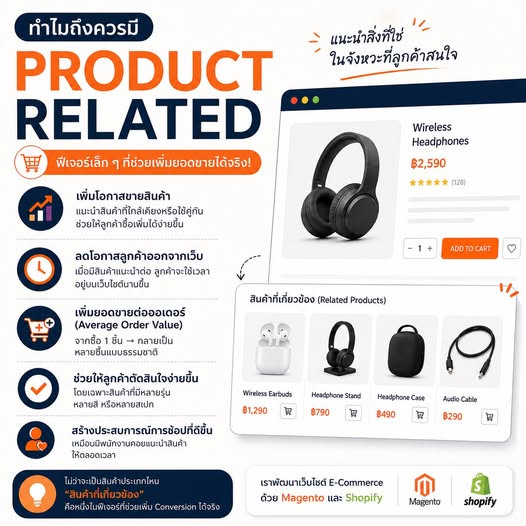
Why Should Every E-Commerce Website Have Related Products?
Customers do not always visit an online store looking for only one specific product.
Sometimes they are interested in a product but have not yet found the right model, color, size, specification, or alternative that best meets their needs.
This is where Related Products can play an important role in an E-Commerce website, helping customers discover relevant alternatives and complementary products without having to restart their search.
What Are Related Products?
Related Products are product recommendations associated with the item a customer is currently viewing.
They may include similar products, alternative models, complementary items, or accessories that can be used together with the main product.
For example:
- Viewing a smartphone → recommend cases and screen protectors
- Viewing running shoes → recommend socks and running accessories
- Viewing cosmetics → recommend complementary beauty products
- Viewing a shirt → recommend alternative colors or similar styles
- Viewing electronics → recommend compatible accessories
This type of recommendation can act like a digital sales assistant helping customers during their shopping journey.
1. Create More Opportunities for Additional Sales
When customers are viewing one product, showing relevant recommendations at the right moment can introduce them to other products without requiring an additional search.
For example, when a customer is purchasing a camera, the website could recommend:
- Memory cards
- Camera bags
- Additional batteries
- Tripods
- Compatible lenses
A customer who originally intended to purchase one item may naturally decide to add additional products to the cart.
2. Give Customers More Reasons to Stay on Your Website
If a customer visits a product page and discovers that the product does not completely meet their needs, they may leave the website and search elsewhere.
However, displaying alternatives such as:
- Different models
- Alternative colors
- Different sizes
- Higher or lower specifications
- Products within a similar price range
gives customers additional options to explore without leaving the store.
3. Increase Average Order Value (AOV)
Related Products can also support a cross-selling strategy designed to increase Average Order Value (AOV).
For example, a customer may initially intend to purchase a product worth 1,500 Baht. The website recommends a useful complementary item worth 300 Baht.
If the customer decides to purchase both, the order value increases from 1,500 Baht to 1,800 Baht without requiring the business to acquire another customer.
4. Help Customers Make Better Product Decisions
Some product categories contain a large number of options, including:
- Multiple models
- Different colors
- Different sizes
- Different specifications
- Different price points
Related Products make it easier for customers to explore and compare alternatives and may help them discover a product that better matches their requirements.
Platforms such as Magento E-Commerce provide extensive product management and commerce capabilities for businesses with more complex product catalogs and sales requirements.
5. Create a Better Shopping Experience
A good E-Commerce experience should not require customers to search for everything by themselves.
Instead, the website should guide customers toward relevant products at appropriate stages of the shopping journey.
Related Products can provide guidance similar to a sales assistant by helping answer questions such as:
- What products can be used with this item?
- Are there similar models available?
- Are there useful accessories I should purchase?
- Is there another option that better matches my budget?
This can make product discovery easier and create a more natural shopping experience.
Related Products vs Cross-sell vs Upsell
Although these features all involve product recommendations, they can serve different purposes.
Related Products
Recommend similar or relevant products to provide customers with additional choices.
Cross-sell
Recommend complementary products that can be purchased with the main item, such as a smartphone case and screen protector with a new phone.
Upsell
Recommend an upgraded or higher-value alternative, such as moving from a standard product to a Pro model with additional features.
When these strategies are used appropriately, they can create a customer journey that helps shoppers discover products while increasing opportunities for additional revenue.
Where Should Related Products Be Displayed?
The placement of product recommendations can have a significant impact on the shopping experience.
Common locations include:
- Below the product details on the Product Detail Page
- Near the Add to Cart section
- Mini Cart
- Shopping Cart
- Checkout, where it does not interrupt the payment process
- Post-purchase or order confirmation pages
The goal should not be to display as many recommendations as possible. Instead, businesses should prioritize products that are genuinely relevant to what the customer is currently considering.
Does Magento Support Related Products?
Businesses using Magento features can take advantage of a range of product and commerce capabilities, including Related Products, Promotion Rules, Color Swatches, Reviews & Ratings, and Product Comparison.
Stores built on Shopify or other E-Commerce platforms can also implement product recommendation experiences based on the business's catalog structure and customer journey.
Recommendations Should Be Relevant, Not Random
The objective of Related Products is not to display the largest possible number of items. It is to show the right product at the right moment.
Businesses can consider factors such as:
- Product category
- Compatible products
- Price range
- Customer purchasing behavior
- Products frequently purchased together
- Available inventory
- Campaigns and promotions
The more relevant the recommendation is, the more useful it feels to the customer rather than simply appearing as another advertising area.
Why Should an E-Commerce Website Have Related Products?
Related Products may appear to be a small E-Commerce feature, but they can support several important stages of the customer journey.
- Help customers discover more products
- Create additional cross-selling opportunities
- Encourage customers to continue exploring the website
- Support higher Average Order Value
- Make product comparison and selection easier
- Create a better shopping experience
Whether your store uses Magento, Shopify, or another E-Commerce platform, the goal should not simply be to enable a Related Products feature.
Recommendations should be relevant, displayed at the right stage of the shopping journey, and designed to naturally support the customer's purchasing decision.
Sometimes, additional revenue can begin with the right product recommendation at the right moment.
Want Your E-Commerce Website to Recommend Products More Effectively?
Build an E-Commerce experience with Related Products, Cross-selling, Upselling, promotions, and product recommendations designed around your catalog and customer journey to create more opportunities for additional purchases and higher order values.
Consult Our Experts


