


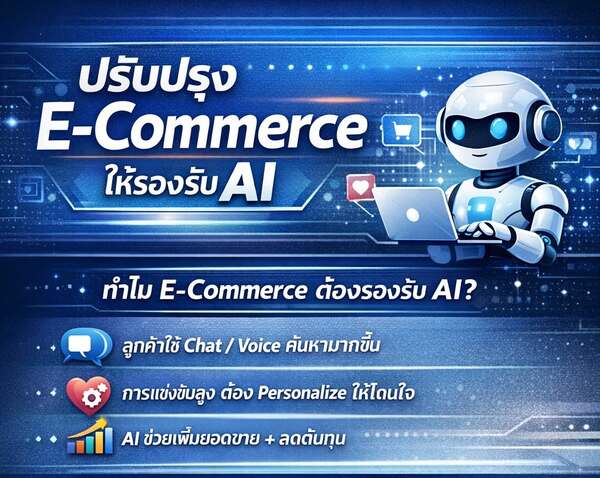
How to Upgrade Your E-Commerce Website for AI
As customer behavior continues to evolve, an E-Commerce website should do more than simply display products and process orders.
By incorporating Artificial Intelligence (AI), businesses can use customer and product data to create more relevant recommendations, improve product discovery, automate repetitive tasks, and deliver more personalized shopping experiences.
Building an AI-ready E-Commerce website can therefore help businesses use data, automation, and personalization to support better customer experiences and stronger sales opportunities.
What Is AI for E-Commerce?
AI for E-Commerce refers to the use of AI and Machine Learning to analyze product, customer, and behavioral data and use those insights to improve the online shopping experience.
Common AI use cases include:
- AI Product Recommendations
- AI Chatbots and Virtual Assistants
- Smart Search and Semantic Search
- Personalized Content
- Customer Segmentation
- Behavioral Analysis
- Marketing Automation
- AI-assisted Product Content
1. Recommend Products Based on Customer Interests
One of the most practical applications is AI Product Recommendation.
Instead of showing exactly the same products to every visitor, the system can use signals such as:
- Previously viewed products
- Purchase history
- Preferred categories
- Cart activity
- Products frequently purchased together
- Behavior of similar customer segments
to recommend more relevant products at appropriate moments.
For example, a customer viewing running shoes could be shown running apparel, socks, or relevant accessories rather than unrelated products.
This approach can also support Related Products, Cross-selling, and Upselling strategies to create more opportunities for additional purchases and higher Average Order Value.
2. Use AI Chatbots to Assist Customers 24/7
Customers often have questions before completing a purchase, such as:
- Is this product suitable for me?
- Is it in stock?
- How long does delivery take?
- Are other sizes or colors available?
- How do I use this product?
- Which model best fits my requirements?
An AI Chatbot can help answer common questions quickly, including outside normal customer service hours.
When properly connected to product information, FAQs, order data, and business knowledge, an AI assistant can reduce repetitive customer service tasks and provide faster access to information.
More complex cases, payment issues, or situations requiring human judgment should still be escalated to a human support agent.
3. Make Product Discovery Easier with AI Search
Traditional site search often depends heavily on exact keyword matching. This can create problems when customers use different words from those stored in the product catalog.
For example, customers may search for:
- “Shoes for marathon running”
- “Gift for men under 2,000 Baht”
- “Professional shirt for work”
- “Phone with a great camera and long battery life”
AI Search or Semantic Search can be designed to interpret the intent or meaning behind these queries rather than relying only on exact text matches.
This can improve product discovery, particularly for online stores with large product catalogs.
4. Analyze Customer Behavior for Better Marketing Decisions
E-Commerce websites generate a large volume of behavioral data, including:
- Page Views
- Product Views
- Add to Cart
- Checkout
- Purchases
- Search Queries
- Customer Segments
- Purchase Frequency
AI and analytics systems can help identify patterns and turn this data into useful business insights.
For example:
- Which customers are most likely to purchase again?
- Which products are frequently purchased together?
- Which promotions appeal to specific customer segments?
- Which products should be cross-sold?
- Where do customers drop out of the purchase journey?
These insights can support Remarketing, Customer Segmentation, and Personalized Marketing strategies.
5. Create Personalized Shopping Experiences
Traditional E-Commerce websites often show the same banners, products, and promotions to every visitor.
With the right customer data and AI infrastructure, businesses can create a more personalized customer experience.
For example:
- New customer → First Purchase Promotion
- Returning customer → Products related to previous purchases
- Customer interested in Category A → Relevant Category Campaign
- High-value customer → Exclusive benefits or offers
The goal is to move from a generic product catalog toward a shopping journey that responds more intelligently to different customer needs.
6. Reduce Manual E-Commerce Work with AI and Automation
AI can also support internal teams, not just customers.
Potential use cases include:
- Product categorization
- Product description assistance
- Meta Title and Meta Description generation
- Customer review summarization
- Analysis of frequently asked questions
- Identifying patterns in orders and customer data
- Helping customer service teams retrieve answers faster
When combined with an integrated E-Commerce and back-office architecture, AI and automation can reduce repetitive manual tasks and allow teams to focus on higher-value activities.
7. Prepare Your Website for AI Search Engines
AI in E-Commerce is not limited to features inside the online store. Businesses should also consider how their website content can be understood by search engines and emerging AI search experiences.
An AI-ready website architecture can include:
- Semantic HTML
- Clear Heading Structures
- Structured Data and Schema Markup
- Complete Product Information
- FAQ Content
- Internal Linking
- High Website Performance
Developing a website designed for SEO and AI Search can help create a stronger technical foundation as search behavior continues to change.
Businesses can also explore AI SEO and AI Search Optimization to better understand how AI-powered search is changing content discovery.
How Can AI Support E-Commerce Sales?
AI does not automatically guarantee higher sales, but it can improve the conditions that support conversion when combined with the right data and customer journey.
Potential benefits include:
- More relevant product recommendations
- Less repetitive administrative work
- Faster customer assistance through AI Chatbots
- Improved product discovery through Smart Search
- Better customer understanding through data analysis
- More personalized experiences
- More opportunities for repeat purchases
Good Data and Architecture Should Come Before AI
Adding AI to an E-Commerce website does not mean installing a chatbot or plugin and expecting immediate results.
The underlying system should have a solid foundation, including:
- Structured product data
- Accurate inventory and pricing
- Usable customer data
- Analytics and event tracking
- APIs for system integration
- ERP, OMS, or CRM connectivity
- Appropriate privacy and customer data management practices
AI should therefore be treated as part of the E-Commerce architecture rather than as an isolated add-on.
Can Existing E-Commerce Platforms Support AI?
Yes. AI capabilities can be implemented across Magento, Shopify, WooCommerce, and custom E-Commerce platforms, although the implementation approach depends on the platform and business requirements.
For example, Shopify E-Commerce can extend functionality through App Integrations, APIs, and external services, while Magento and custom platforms can support more specialized integrations and workflows depending on the architecture.
What Is an AI-Ready E-Commerce Website?
An AI-ready E-Commerce website is more than a website with a chatbot. It should be able to use product, customer, and behavioral data to create better shopping experiences.
Key capabilities may include:
- AI Product Recommendations
- AI Chatbots
- Smart and Semantic Search
- Personalization
- Customer Data and Analytics
- Automation
- API and System Integration
- SEO and AI Search-Friendly Architecture
AI should therefore be viewed not simply as a trend, but as an additional technology layer that can make E-Commerce systems more responsive, data-driven, and useful to both customers and business teams.
Ready to Make Your E-Commerce Website AI-Ready?
Upgrade your E-Commerce platform with AI Product Recommendations, AI Chatbots, Smart Search, Personalization, and Data Analytics, together with ERP, OMS, CRM, inventory, and API integrations to improve customer experiences, reduce manual work, and prepare your business for the AI-driven commerce era.
Consult Our Experts


