


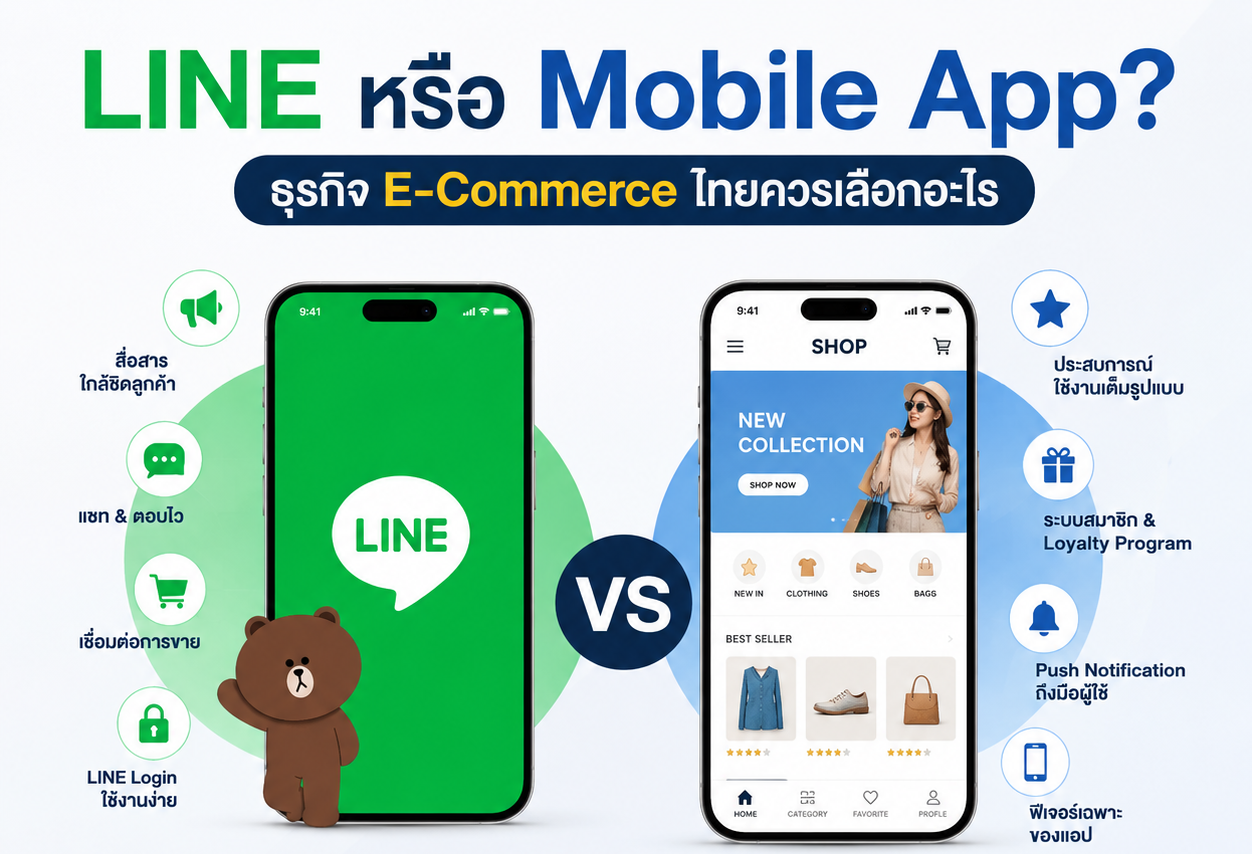
Do You Need a Mobile App or LINE?
Before building a native mobile app for a Thai E-Commerce business, it is worth looking at what LINE Official Account can already do for your customers and your business.
The key question is not simply, “Does my business need an app?” Instead, ask: “What can a mobile app do that LINE cannot?” And more importantly, are those additional capabilities worth the cost of building and maintaining an app over the long term?
Why LINE Is Different in Thailand
In many markets, messaging apps are simply another communication channel. In Thailand, however, LINE plays a much larger role in everyday digital life, making LINE Official Account an important channel for businesses to communicate with and engage their customers.
For E-Commerce businesses, customers can discover brands, ask questions, receive promotions, follow updates, and interact with businesses through LINE without having to download another app.
This is one of LINE's biggest advantages. Businesses can reach customers through a platform they already use instead of asking them to develop a new habit and install another application.
Where LINE Alone May Not Be Enough
While LINE can be highly effective for communication and customer engagement, it does not necessarily replace a website or mobile app in every situation.
Customers may still need to visit a website to browse detailed product information, compare products, configure complex options, add items to a shopping cart, or manage their accounts and orders. LINE therefore works best as part of an omnichannel customer journey rather than as the only digital channel.
Businesses that use LINE effectively typically combine several features rather than relying only on broadcasts, including:
- Broadcast Messages for promotions and updates
- LINE Chat for customer support and one-to-one communication
- Rich Menu for quick access to products, services, and systems
- Sales and service functions integrated with the business's existing systems
LIFF: A Middle Ground Before Building a Native App
LIFF (LINE Front-end Framework) is another option for businesses that need a richer experience than a standard LINE chat but are not yet ready to invest in a native mobile app.
LIFF allows businesses to create web-based applications that run within the LINE environment, such as forms, product selection, membership systems, loyalty programs, or dashboards, without requiring customers to download a separate app.
For businesses that are unsure whether a native app is worth the investment, LIFF can be a practical way to test new features and measure customer demand before committing to a full-scale mobile application.
When Is a Native App Worth the Investment?
A native mobile app is a long-term investment. The cost goes beyond initial development and can include ongoing maintenance, operating system updates, App Store and Google Play management, bug fixes, and continuous feature development.
A native app becomes more valuable when a business has clear reasons to own its own mobile channel, such as:
- High purchase frequency — Businesses with frequent repeat purchases can use Push Notifications to encourage customers to return and increase engagement.
- Features that LINE or a standard website cannot deliver effectively — For example, advanced loyalty programs, AR experiences, offline functionality, or highly specialized app-based interfaces.
- A large and established customer base — An app does not automatically create an audience. It is primarily a tool for serving and increasing the value of an audience the business already has.
When developing a mobile app for the Thai market, businesses should also consider the devices customers actually use. Supporting a wide range of Android devices and mobile networks is important, especially when real-world users may experience different performance conditions from those seen on high-end devices and Wi-Fi connections.
The Long-Term Costs Businesses Often Underestimate
The cost of a mobile app does not end when the app launches. Both iOS and Android receive continuous operating system updates, which may require businesses to update their apps to maintain compatibility and performance.
There are also ongoing costs associated with bug fixes, UX/UI improvements, new features, backend maintenance, and managing the application on the App Store and Google Play.
For this reason, a native mobile app should be viewed as a long-term investment rather than a one-time development project. Businesses should plan for ongoing maintenance and development before starting the project.
Push Notifications Are Not Automatically Accepted by Everyone
One of the major advantages of a mobile app is Push Notification, which allows businesses to send direct notifications to app users.
However, installing an app does not mean that users will automatically allow notifications. Users can decline or disable notifications, so businesses should consider actual notification opt-in and engagement rates when evaluating the value of an app.
LINE Official Account, meanwhile, provides a familiar communication channel that customers can access without installing another application. Businesses should therefore compare reach, engagement, and the total cost of each channel before making a decision.
A Practical Starting Point
For growing Thai E-Commerce businesses, starting with channels that customers already use can be a practical approach. This can begin with improving the performance of the LINE Official Account, for example:
- Planning broadcasts based on customer segments
- Designing an easy-to-use Rich Menu
- Using LINE Login to simplify account registration
- Improving chat and customer service response times
- Connecting LINE with the website and E-Commerce system
If the business needs more advanced functionality, LIFF or a Mini App can be considered as a way to test customer demand. Once the business has a sufficiently large customer base, high purchase frequency, or specific requirements that LINE cannot effectively support, investing in a native mobile app may become a more logical next step.
Conclusion
LINE and mobile apps do not necessarily have to compete with each other. They can work together as different parts of the customer journey.
For many E-Commerce businesses, starting with LINE Official Account, which customers are already familiar with, then considering LIFF or a Mini App to test more advanced functionality, and eventually developing a native app when there is a clear business case can help allocate budgets more effectively and reduce unnecessary investment.
The most important question is therefore not “Should we use LINE or a mobile app?” but rather “Which channel best fits our customers' behavior and our business goals?”
Not Sure Whether You Need LINE, LIFF, or a Mobile App?
Plan your E-Commerce and mobile app strategy around your customers' behavior, while designing the user experience and system integrations needed to support your business in the long term.
Talk to Our Experts


