


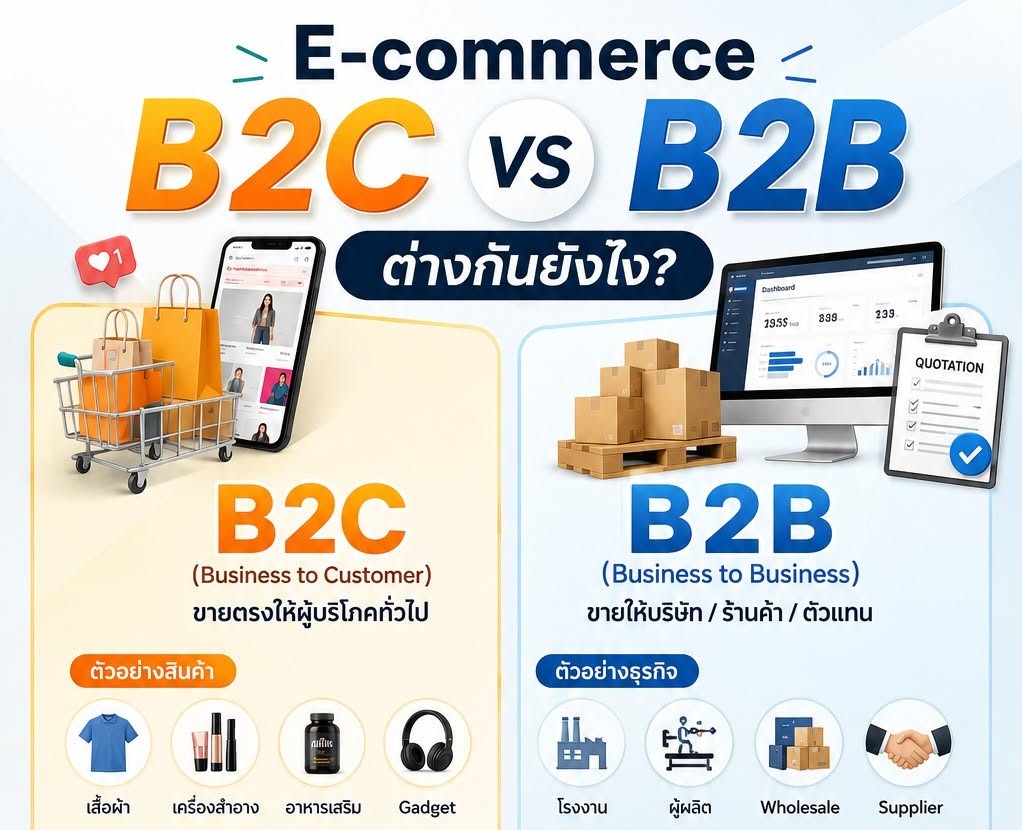
B2C vs B2B E-Commerce: What’s the Difference?
Many businesses assume that every online store works in essentially the same way. In reality, an E-Commerce website designed for individual consumers, or B2C (Business to Consumer), can be very different from a website designed for companies, distributors, or business customers, known as B2B (Business to Business).
The target audience, purchasing process, pricing structure, website features, and back-office integrations can all be significantly different.
What Is B2C E-Commerce?
B2C, or Business to Consumer, refers to businesses selling products or services directly to individual consumers.
Examples of B2C businesses include:
- Fashion and apparel
- Cosmetics and beauty products
- Food and supplements
- Gadgets and electronics
- Lifestyle products
Key Features of a B2C E-Commerce Website
- Attractive and engaging website design
- Simple product browsing and purchasing
- Promotions, coupons, campaigns, and customer reviews
- Mobile-friendly shopping experience
- Fast and convenient checkout and payment processes
- A user journey designed to reduce purchase friction
The primary goal of B2C E-Commerce: help customers discover products, build interest, and complete their purchases as quickly and easily as possible.
What Is B2B E-Commerce?
B2B, or Business to Business, refers to transactions between businesses. Typical customers may include companies, factories, retailers, distributors, wholesalers, and suppliers.
Because B2B purchasing processes are usually more complex, a B2B E-Commerce website often requires specialized features that support business customers and internal purchasing workflows.
Examples of B2B businesses include:
- Manufacturers
- Distributors
- Wholesalers
- Suppliers
- Industrial businesses
- Companies selling products to retailers or other organizations
Key Features of a B2B E-Commerce Website
- Business customer accounts
- Wholesale or customer-specific pricing
- Request for Quote (RFQ) and quotation systems
- Bulk ordering
- Quick Order using SKU or product codes
- Reorder functionality for frequently purchased products
- Credit terms and customized commercial conditions
- Integration with ERP, inventory, CRM, and accounting systems through APIs
The primary goal of B2B E-Commerce: simplify purchasing and sales operations while reducing manual processes between customers, sales teams, and back-office systems.
What Is the Main Difference Between B2C and B2B?
In simple terms:
- B2C = Make purchasing simple and fast
- B2B = Make pricing, ordering, and business workflows easier to manage
B2C websites typically focus on product discovery, promotions, user experience, and fast checkout. B2B websites often require more advanced capabilities such as customer-specific pricing, quotation workflows, approval processes, credit terms, bulk ordering, and ERP or CRM integration.
Should You Build a B2C or B2B E-Commerce Website?
Before developing an E-Commerce website, one of the most important questions to answer is: “Who are your customers?”
If your customers are primarily individual consumers, the website should make product discovery, purchasing, and payment as simple as possible.
If your customers are companies, retailers, distributors, or business partners, the website should be designed from the beginning to support B2B purchasing processes and business-specific workflows.
Choosing the right E-Commerce solution for your business allows your website to become more than just an online sales channel. It can connect sales, customer management, inventory, and back-office systems into a more efficient digital commerce platform.
Planning a B2C or B2B E-Commerce Website?
Our team can help analyze your business model and develop the right E-Commerce solution, from online sales and customer accounts to B2B pricing, quotation workflows, and ERP, inventory, or CRM integrations.
Consult Our Experts


